JFET Design Spotlight: Keeping It Simple Whenever We Can
Sometimes the most effective analog solutions are also the simplest. This design demonstrates how a low-noise, high-gain differential amplifier can deliver excellent linearity, wide bandwidth, and fast transient response without feedback.
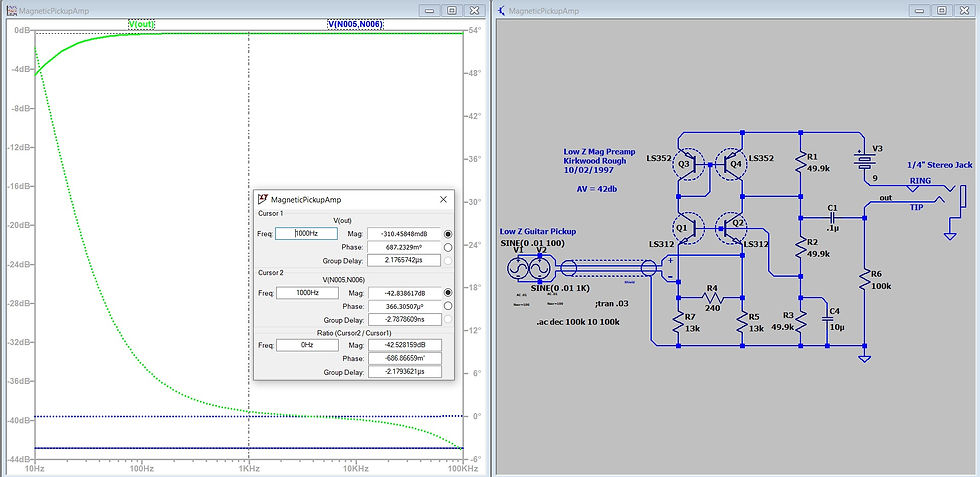
“The sensing and manipulation of differential signals can take on a myriad of configurations using all types of semiconductor types and vacuum tubes. Inputs have all ranges of impedances, all ranges of source loading conditions, and what becomes of that signal: current gain, voltage gain, bandwidth, reflected circuit dynamics, differential or single-ended through conversion, group delay, feedback phase error over frequency, or any other quandary needing definition. For this case, there was a defined task requiring utmost simplicity, high performance, and a wide range of voltage operation to gain up a small low-Z guitar pickup. For this low an impedance, a differential emitter input was chosen, being in the range of the pickup’s impedance character and its limited voltage output of <15 mV. The differential input impedance of this bipolar emitter pair is 25 mV / 185 µA × 2 = 270 Ω, or a damping coefficient of about 3:1 relative to the pickup impedance including the shunt resistor. A high-Q coil will ring if not properly terminated and results in unwanted odd voicing. Small signals have an advantage in amplification where high gain can be linear without feedback as long as the signal is less than the square law voltage effects of the differential junctions. Linear operation is less than 14 mV differential input for silicon bipolar transistors operating either common emitter or common base. Because of the low-Z input, a grounded base, differential emitter is used. As is typical, using an LS352 PNP mirror to ratio the differential LS312 NPN pair currents into a single-ended output works well and could be increased to 60 dB of gain if a larger operating current were tolerable. Here, the circuit draws less than 0.5 mA and has an output impedance of about 25 kΩ. Circuit gain is 42 dB operating from a 9 V battery. Being a non-feedback gain circuit, frequency response is flat up to 200 kHz, has low harmonic content and acute transient response without overshoot or ringing. Though designed for a specialized bass guitar pickup, this approach is easily seen as a drop-in for other instrumentation applications. The step response is shown with square wave 300 ns rise and fall times ±10 mV input.
As usual …… Kirkwood Rough”


Precision analog performance starts with the right components.
Linear Systems' low-noise JFETs and precision bipolar transistors provide engineers with proven building blocks for audio, instrumentation, sensor interfaces, and other demanding analog applications.
Explore our semiconductor solutions and request free evaluation samples: